There is no Santa Claus — An Interview with Ben Hanson
This is a blog post from my archive. Originally written January 26, 2025.
There’s been a shift in the games industry—and I don’t mean a shift in the games themselves. In fact, we can see, through a 2015 The Guardian Article, that many of the actual game issues, are strangely quite the same. In the article, The Guardian interviewed Nicholas Lovell, founder of Gamesbrief, a site that was dedicated to examining the business side of games. Many of the issues he covered there, and many of the issues reported on in the article, seem to mirror some of the problems we find in the industry today. He saw the rise of free-to-play games, and speculated that we would see that microtransaction heavy economy take over. A genre that would eventually morph into the live service goliaths we see in Fortnite, Warzone, and others. He sees VR as a struggling medium, still trying get it’s footing, a sentiment that you could literally copy-paste into an article today, and no one would think anything of it. He also sees the industry heading to massive consolidation. While in current day, we’ve just cleaned up the Microsoft acquisition of Activision, Embracer ran it’s pockets a few years back, and countless other consolidation efforts have been made industry wide, such as Sony’s purchase of Bungie, Microsoft buying ZeniMax, TakeTwo with Zynga, etc, etc. So through that lens, it’s obvious to tell I’m not talking about a shift in the game-making sector. No, instead, I’m talking about the games-reporting sector. It’s a space that, for a long time, was dominated by big publications with huge staffs, brick and mortar offices, and corporate leadership. I’d argue there was a 10-ish year stretch, where all of the biggest news sites were simultaneously big companies. As a kid, the only places for me to find the most up-to-date news, the best reviews, and the widest net of content was with companies like IGN, GameInformer, Gamespot, and Kotaku. These are all companies that have corporate owners, profit incentives, and hierarchy. That’s not to say these sites are bad, in fact, I still buy GameInformer’s physical magazines, and I love GameSpot’s After Dark podcast. But the corporatization of media does have one inevitable obstacle. These companies are not agile. They suffer layoffs when the industry hits a low point, they have brand deals and quotas to hit, and they have a general obligation to cover anything and everything that happens in the space. Whereas the general advice for content creators, YouTubers, and new games journalists is to specialise. To find a niche, and become the single most respected voice for that audience. But when you have salaries to pay, margins to hit, and performance metrics to reach you simply can’t condense the topics of your coverage, and with a shrinking audience there’s nothing to do but face layoffs, pay cuts, or shut your doors entirely. But it doesn’t mean games journalism is doomed. There’s an easy fix for all of these issues, and while the fix has some problems of its own, it seems to be the way the industry is heading, and all the better for it.
2023 was the year of the independent media push. In the games space alone, we saw Kotaku, WaPo, and Vice reporters create AfterMath, a subscription funded games and internet pop-culture site. We saw Yahtzee Croshaw, Nick Calandra, and the rest of The Escapist’s video team leave to create Second Wind, a YouTube channel and podcast publication that’s main source of funding is from listeners and watchers via Patreon. We also saw Stephen Totilo leave Axios and create his own newsletter via Substack. We have seen both the growth of homegrown independent media, as well as defectors from the corporate-led world to lead this charge into a much more viewer and audience funded system. And while this grand push to become independent is recent, the ideas and blueprints used by these new publications are not.
When Nick Calandra and his team left the Escapist, he posted to Twitter about independent media groups he used as inspirations in crafting the future of his new platform. He mentions noclip, a games documentarian team also funded through Patreon, he mentions Defector Media, a media company founded by ex-Deadspin employees, and he also mentions MinnMax. MinnMax was created in 2019 when GameInformer (GI) laid off a number of their staff. Ben Hanson was a host and GI’s video producer at the time. He saw these layoffs take place and felt it was time to branch off, create something that, in his words, was more “fun, consistent, and sustainable.” So, Ben led a team of three ex-GI employees and started a little podcasting channel called MinnMax (the two ns are for the two ns in Minneapolis and Minnesota, where they’re based.) They’ve been going strong and growing for the past 5 years, posting weekly podcasts and shows via YouTube and their Patreon, holding yearly fundraisers for Connections To Independence, and cultivating an audience, as Ben opens the show with every week, focused on games, friends, and getting better. This past week I had the opportunity to interview Ben Hanson where we talked a lot about the differences between a business led environment like that of GI’s compared to MinnMax, the move to independent media, the growth but innate difficulties of the medium, and lessons learned in his years so far.
“I really loved my job at Game Informer.” Ben says, “I wanted to maintain a lot of the big beats like keeping in touch with developers through interviews and podcasting about games with a group ... and trying to unpack this entire medium as it speeds along.” These are things that have not changed since the move to MinnMax. Ben and his team interview devs, they review new games, they talk about the news, everything you’d expect from a games media publication. Much of which is the same since the GameInformer days, but GameInformer was not a perfect publication. “I didn’t want to carry over any of the busy work at MinnMax, I’m obsessed with being as efficient as possible.” he continues, “ I wanted to have focused attempts at trying formats for game coverage, not an anything goes approach.” It’s something easily visible with the format of MinnMax and how it operates. If you click on a 2 hour podcast about the new games releasing, that’s what you get. A few friends in a (virtual) room, talking about the medium they love. And if an idea for a certain show doesn’t work out, or it’s not what they planned, that’s okay! They’re able to be agile and morph into what their audience needs. They even have an entire show slot dedicated to this experimentation, New Show Plus. “I think some outlets will get weighed down by decision making or coming up with worst case scenarios for why something wouldn’t work … But we have a show format called New Show Plus that allows for weekly experimentation, a lot of that can be sloppy and fun but it’s a great place to try out ideas and see what connects with the community…”
It’s not all a perfect world, though. While being independent means you’re able to meet your audience where they want to be, it also means you’re completely dependent on that same group to pay your salary, and to pay your team. On top of that, it’s never an easy task keeping up with audience demands. It’s a medium that is fragile. In many ways your job is based on unknowable variables. Is the algorithm sending our videos out? Is this what our audience wants? At GameInformer, the publication was owned by GameStop. So if things got really dire on the media side, you had an entire international business backing you up when things were rough. On the independent side, you don’t have those liberties. It gets even harder if you’re starting from zero. Second Wind had long-standing heroes of the industry like Yahtzee Croshaw, and new upcoming talent like Sebastian Ruiz joining the team and bringing their fans with them. If you’re trying to break in on the independent side it’s a lot harder. “I don’t think anybody should bank on being a content creator in any way. Stay away! But if you’re really passionate about a topic then build it up as a side hobby and see how it goes... Don’t put all your eggs in the least reliable basket.” To start from zero and build to something sustainable, you have to work incredibly hard, you have to be talented, and most of all, you have to be lucky. Even with his success, Ben Hanson wants to keep those risks in mind. But at the same time, he doesn’t want to burn himself out. “What feels like the end of the world to me like if we don’t have our best spokesperson on a specific game right when it launches, or if the podcast is 4 hours late to go … it’s all good.” “I can definitely still learn a lot from the idea that I can slow down a bit and this entire thing won’t collapse, because if I go as hard as I want to go it will 100% impact the health of my marriage and family.” So instead, he wants to maintain an environment of being focused, and flexible. Ben tells us to “Be more patient and take bigger swings." If you can build it up sustainably, make sure you’re not being risky, and work extremely hard, it’s a rewarding, fun, and satisfying career.
“I love my job, personally. I think I have the best position in games media, honestly. I got super lucky. But even I have days where I want to unplug from the entire thing. Everybody gets numb to every blessing. And there is no Santa Claus. But it is fun, most of the time!”
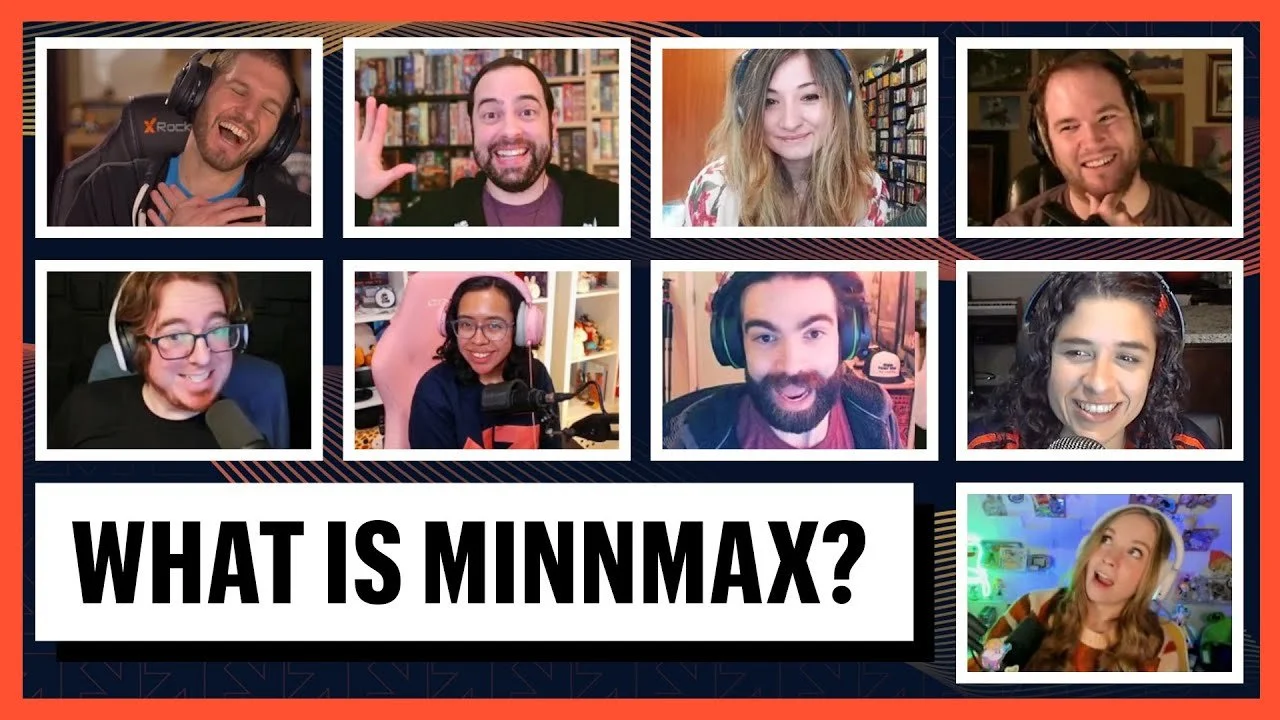
“An Introduction To MinnMax” YouTube Video
MinnMax is an independent games media outlet funded by the community on Patreon, formed by game industry veterans from Game Informer, IGN, 8-4 (localization), The Game History Foundation, and more. The regular team consists of Ben Hanson, Kyle Hilliard, Jeff Marchiafava, Leo Vader, Janet Garcia, Sarah Podzorski, Kelsey Lewin, and Haley MacLean. MinnMax's biggest shows are The MinnMax Show, New Show Plus, The Deepest Dive, Trivia Tower, Party Chat, MinnMax Interviews, and Max Spoilers. You can unlock benefits and help support independent games media directly on Patreon!